
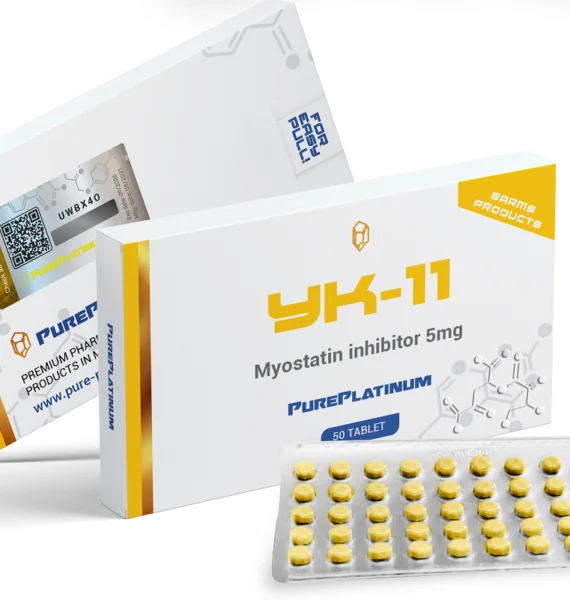
Description
Pure YK-11 (CAS 1370003-76-1) belongs to a unique class of synthetic compounds. Its molecular formula is C₂₅H₃₄O₆. Researchers classify it as a selective androgen receptor modulator (SARM). However, YK-11 differs significantly from non-steroidal SARMs like Ostarine or Ligandrol. Specifically, it possesses a steroidal backbone derived from dihydrotestosterone (DHT). This structural distinction gives YK-11 a remarkably different mechanism of action. Consequently, researchers find this compound particularly intriguing for muscle and bone studies.
The Dual Mechanism That Sets YK-11 Apart
YK-11 operates through two distinct and complementary pathways. First, it acts as a partial agonist of the androgen receptor (AR). This means it binds to the AR. However, it does not trigger the full transcriptional activation that potent androgens like DHT typically produce. Therefore, researchers theorize that YK-11 may offer more tissue-selective effects. It might also produce fewer androgenic side effects in non-target tissues like the prostate or skin.
Second, and more importantly, YK-11 powerfully upregulates the expression of follistatin. Follistatin is a protein that binds to and neutralizes myostatin. Myostatin acts as a negative regulator of skeletal muscle growth. In essence, myostatin functions as a “brake” on muscle hypertrophy. Thus, by increasing follistatin levels, YK-11 effectively removes this brake. Furthermore, researchers have confirmed this myostatin-inhibiting pathway experimentally. For instance, adding an anti-follistatin antibody completely reverses YK-11’s myogenic effects in cell cultures.
What Does the Research Show?
Most existing research on YK-11 comes from in vitro studies using C2C12 mouse myoblasts. These experiments have produced promising results. For example, YK-11 promotes myogenic differentiation. It also significantly upregulates key myogenic regulatory factors (MRFs) such as MyoD, Myf5, and myogenin. Interestingly, YK-11 demonstrated greater potency than DHT itself in inducing these factors. This finding surprised many researchers.
Moreover, one of the few in vivo studies investigated YK-11 in a mouse model. This model simulated sepsis-induced muscle wasting. In that experiment, oral administration of YK-11 at 350 mg/kg and 700 mg/kg lasted for 10 days. Consequently, the treatment successfully prevented muscle mass loss. Furthermore, it even increased total body weight in the septic mice. Additionally, research has revealed that YK-11 possesses osteogenic activity. Specifically, it accelerates osteoblast proliferation and differentiation. Therefore, this compound may offer a dual anabolic effect. It could benefit both muscle and bone tissue simultaneously.
Critical Safety Concerns and Regulatory Status
Despite its intriguing mechanism, YK-11 carries a concerning safety profile. Regulatory agencies have not approved it for human use. The World Anti-Doping Agency (WADA) explicitly lists YK-11 on its Prohibited List. It falls under the category of anabolic agents. Consequently, athletes cannot use it legally in competition. Furthermore, safety data sheets classify YK-11 as a toxic substance. They cite potential risks such as irritation and possible impaired fertility. Additionally, there is a risk of harm to an unborn child.
A 2023 rat study raised additional alarms. It revealed that YK-11 can cross the blood-brain barrier. Furthermore, it induces oxidative stress in the hippocampus. It also causes mitochondrial dysfunction in that brain region. Hence, researchers now suspect potential neurological risks. These risks warrant further investigation. While YK-11 may present a different safety profile than traditional anabolic steroids, long-term effects remain unknown. Testosterone suppression and hepatotoxicity are also significant concerns. Therefore, researchers should handle this compound with extreme caution. They should only use it within controlled laboratory settings.
Conclusion
In summary, YK-11 represents a fascinating research compound. Its dual mechanism involves partial AR agonism and follistatin-mediated myostatin inhibition. Preclinical studies have shown promising anabolic and osteogenic activity. However, the compound’s severe safety concerns are alarming. Its regulatory bans are unequivocal. Its potential neurotoxicity is deeply troubling. Consequently, these risks far outweigh any theoretical benefits. Therefore, researchers must treat YK-11 as a high-risk investigational tool. It is not a viable therapeutic candidate.
Internal Links (Hypothetical for a research chemical website):
-
/products/yk-11/: View our research-grade YK-11.
-
/research-education/sarms-guide/: Learn the difference between steroidal and non-steroidal SARMs.
-
/research-education/myostatin-pathway/: Deep dive into the science of myostatin inhibition.
-
/blog/androgen-receptor-modulators/: An overview of androgen receptor modulators.
-
/faq/research-compounds/: Frequently asked questions about research compounds.
External Links:
-
NCATS Inxight Drugs (YK-11 Chemical Data): https://drugs.ncats.io/drug/Z9748J6B0R
-
UK Anti-Doping (YK-11 Prohibited Status): https://www.ukad.org.uk/news/2023-prohibited-list-summary-changes
-
UK Anti-Doping (SARMs Ingredient Warning): https://www.ukad.org.uk/supplement-ingredient-warnings/sarms-ingredient-warning
-
PubChem (Compound Information): https://pubchem.ncbi.nlm.nih.gov/compound/119058028


Reviews
There are no reviews yet.